
English Wordplay ~ Listen and Enjoy
JAMES BALDWIN 1924 - 1987
I was the one who said you cannot forget me.
You cannot escape me.  I will make you face who you are
and what you believe.
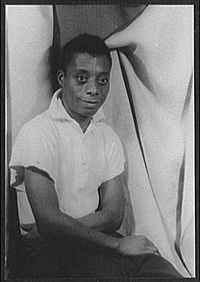
An American novelist, writer, playwright, poet, essayist and civil rights activist.
Most of his work deals with racial and sexual issues in the mid-20th century in the United States.

His novels mine complex social and psychological pressures related to being black and homosexual well before the social, cultural or political equality of these groups was improved.
| PETER: | Did you know who your biological father was? |
| BALDWIN: | I knew who he was, but he was not playing a part in that particular life for me. Psychologically that gave me certain feelings of abandonment,but it also put into perspective the graciousness of my step father, and how he brought the family together. |
| PETER: | I'm interested you call him gracious and kind because he is reputed to have been quite a brutal man. |
| BALDWIN: | (LAUGHS) He had his ways that most would consider brutal. I'm talking "graciousness" as a soul taking on such a position. In point of physical fact, and pardon my French, he was what most would call a "bastard." But I wanted to have the feelings of being in such a cauldron. |
| PETER: | How early on did you become aware of your homosexuality? |
| BALDWIN: | Very early on, because my stepfather was a homophobe. One of the neighbours was gay, so it was a topic on which we were preached at. I would describe myself as an experimenter - sometimes just to see what was there, and sometimes being forced there out of rebellion. My mother had a certain fear that my stepfather would beat me to death. |
| PETER: | What is the soul seeking to achieve in the choice it makes of homosexual orientation? |
| BALDWIN: | It's a very close relationship that allows you to compare notes, so to speak: "I'm having these problems; how do you solve them?" |
| PETER: | As a child you had a great appetite for books. |
| BALDWIN: | They were a place to go to get out of the turmoil that surrounded me. But later I changed to feeling the energy of the author that was in the book, or the energy of the place that the book was written about. Then I got the sense that I might be able to create a world for someone within a book. |
| PETER: | You loved Paris. |
| BALDWIN: | It's a place that seemed to me to accept whatever you wanted to do, whoever you wanted to be. |
| PETER: | You knew how to move hearts, as a teenage preacher in the Pentecostal Church. Was this your religious zeal? Or did you try to please your preacher stepfather? |
| BALDWIN: | I was trying to survive. This way I got my stepfather to not scrutinize me. My success with the way I drew people, he saw as his success. |
| PETER: | What were the chief experiences in your youth that made you such a furiously dedicated opponent of racism? |
| BALDWIN: | Because I was in fear of conflict, racial incidents were drawn to me. I was broadcasting to the universe, "Let me experience that which I fear, that which I have not experienced." Then particularly from my readings, I realised there were parts of the world that were not racist. I began to let everybody know, through my writings, through my talks, that there was another way to live. |
| PETER: | Why were you an alcoholic? |
| BALDWIN: | As a boy I was able to escape into the novel; as I got older I escaped into the bottle. It was a way of numbing the turmoil I felt. |
| PETER: | Two of your friends were the musician and civil rights worker Nina Simone and the painter Beaufort Delaney. |
| BALDWIN: | I loved them dearly because they were both visionaries. |
At this point Baldwin transmitted a picture to the Channel. Toni reported: "The image I am getting now is of one of those Easter eggs that you look into and there is a whole elaborate village inside. From the outside the shell is plain and boring. But look inside the egg and you are transported into a whole new world. So he is saying that is what all three of them could do."
| BALDWIN: | You could go into these arts (whether it be music or painting or literature), become a part of that picturesque egg village and create your whole reality within the beauty, while you were still in your plain wrapper. |
| PET |