
English Wordplay ~ Listen and Enjoy
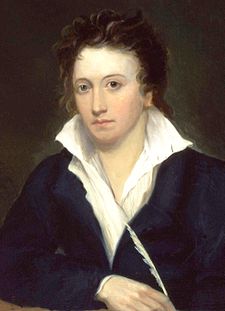 |
| Percy Bysshe Shelley
by Alfred Clint |
These pages are dedicated to the poet's namesake, my step-daughter, Shelley, in the hope they may afford her consolation and enlightenment.
PERCY BYSSHE SHELLEY 1792 - 1822
The Spiritual Atheist
Based on the biography by John Addington Symonds and on Notes to the Complete Poetical Works of Percy Bysshe Shelley by Mary Shelley
From the Verse Drama, The Cenci

BEATRICE [WILDLY]:
O My God! Can it be possible I have
To die so suddenly? So young to go
Under the obscure, cold, rotting, wormy ground!
To be nailed down into a narrow place;
To see no more sweet sunshine; hear no more
Blithe voice of living thing; muse not again
Upon familiar thoughts, sad, yet thus lost -
How fearful! to be nothing! Or to be...
What? Oh, where am I? Let me not go mad!
Sweet Heaven, forgive weak thoughts! If there should be
No God, no Heaven, no Earth in the void world;
The wide, gray, lampless, deep, unpeopled world!
If all things then should be...my father's spirit,
His eye, his voice, his touch surrounding me;
The atmosphere and breath of my dead life!
If sometimes, as a shape more like himself,
Even the form which tortured me on earth,
Masked in gray hairs and wrinkles, he should come
And wind me in his hellish arms, and fix
His eyes on mine, and drag me down, down, down!
CHAPTER 6. JOURNEY TO ITALY AND THE CENCI.
Shelley never returned to England. Four years only of life were left to him - years filled with music that will sound as long as English lasts.
 |
| On the beach at Naples by Oswald Achenbach |
The Shelleys took their departure with Miss Clairmont and the child Allegra. They went straight to Milan, and after visiting the Lake of Como, Pisa, the Bagni di Lucca, Venice and Rome, they settled early in the following December at Naples.
In the following August, Shelley paid a visit to Lord Byron at Venice. He arrived at midnight in a thunderstorm. Julian and Maddalo was the literary fruit of this excursion - a poem which has rightly been characterized by Mr. Rossetti as the most perfect specimen in our language of the "poetical treatment of ordinary things." The description of a Venetian sunset, touched to sadness amid all its splendour by the gloomy presence of the madhouse, ranks among Shelley's finest word-paintings; while the glimpse of Byron's life is interesting on a lower level. Here is the picture of the sunset and the island of San Lazzaro: -
 |
| Sunset at San Lazzaro by Bernhard Stange |
Oh!
How beautiful is sunset, when the glow
Of heaven descends upon a land like thee,
Thou paradise of exiles, Italy,
Thy mountains, seas, and vineyards, and the towers
Of cities they encircle! - it was ours
To stand on thee, beholding it: and then,
Just where we had dismounted, the Count's men
Were waiting for us with the gondola.
As those who pause on some delightful way,
Though bent on pleasant pilgrimage, we stood
Looking upon the evening, and the flood
Which lay between the city and the shore,
Paved with the image of the sky. The hoar
And airy Alps, towards the north, appeared,
Thro' mist, a heaven-sustaining bulwark, reared
Between the east and west; and half the sky
Was roofed with clouds of rich emblazonry,
Dark purple at the zenith, which still grew
Down the steep west into a wondrous hue
Brighter than burning gold, even to the rent
Where the swift sun yet paused in his descent
Among the many-folded hills. They were
Those famous Euganean hills, which bear,
As seem from Lido through the harbour piles,
The likeness of a clump of peaked isles -
And then, as if the earth and sea had been
Dissolved into one lake of fire, were seen
Those mountains towering, as from waves of flame,
Around the vaporous sun, from which there came
The inmost purple spirit of light, and made
Their very peaks transparent. "Ere it fade,"
Said my companion, "I will show you soon
A better station." So o'er the lagune
We glided; and from that funereal bark
I leaned, and saw the city, and could mark
How from their many isles, in evening's gleam,
Its temples and its palaces did seem
Like fabrics of enchantment piled to heaven.
I was about to speak, when - "We are even
Now at the point I meant," said Maddalo,
And bade the gondolieri cease to row.
"Look, Julian, on the west, and listen well
If you hear not a deep and heavy bell."
I looked, and saw between us and the sun
A building on an island, such a one
As age to age might add, for uses vile, -
A windowless, deformed, and dreary pile;
And on the top an open tower, where hung
A bell, which in the radiance swayed and swung, -
We could just hear its coarse and iron tongue:
The broad sun sank behind it, and it tolled
In strong and black relief - "What we behold
Shall be the madhouse and its belfry tower," -
Said Maddalo; "and ever at this hour,
Those who may cross the water hear that bell,
Which calls the maniacs, each one from his cell,
To vespers."
It may be parenthetically observed that one of the few familiar quotations from Shelley's poems occurs in Julian and Maddalo: -
Most wretched men
Are cradled into poetry by wrong:
They learn in suffering what they teach in song.
Byron lent the Shelleys his villa of the Cappuccini near Este, where they spent some weeks in the autumn. Here Prometheus Unbound was begun, and the Lines written among the Euganean Hills were composed; and here Clara became so ill that her parents thought it necessary to rush for medical assistance to Venice. They had forgotten their passport; but Shelley's irresistible energy overcame all difficulties, and they entered Venice - only in time, however, for the child to die.
 |
| Bay of Naples, attributed to Herman van Swanevelt |
Nearly the whole of the winter was spent in Naples, where Shelley suffered from depression of more than ordinary depth. Mrs. Shelley attributed this gloom to the state of his health, but Medwin tells a strange story, which, if it is not wholly a romance, may better account for the poet's melancholy. He says that so far back as the year 1816, on the night before his departure from London, "a married lady, young, handsome, and of noble connexions," came to him, avowed the passionate love she had conceived for him, and proposed that they should fly together. He explained to her that his hand and heart had both been given irrevocably to another, and, after the expression of the most exalted sentiments on both sides, they parted. She followed him, however, from place to place; and without intruding herself upon his notice, found some consolation in remaining near him. Now she arrived at Naples; and at Naples she died.
 |
| Naples by Alessandro La Volpe |
The web of Shelley's life was a wide one, and included more destinies than his own. Godwin, as we have reason to believe, attributed the suicide of Fanny Imlay to her hopeless love for Shelley; and the tale of Harriet has already been told. Therefore there is nothing absolutely improbable in Medwin's story, especially when we remember what Hogg half-humorously tells us about Shelley's attraction for women in London. At any rate, the excessive wretchedness of the lyrics written at Naples can hardly be accounted for by the "constant and poignant physical sufferings" of which Mrs. Shelley speaks, since these were habitual with him. She was herself, moreover under the impression that he was concealing something from her, and we know from her own words in another place that his "fear to wound the feelings of others" often impelled him to keep his deepest sorrows to himself.
All this while his health was steadily improving. The menace of consumption was removed; and though he suffered from severe attacks of pain in the side, the cause of this persistent malady does not seem to have been ascertained. At Naples he was under treatment for disease of the liver. Afterwards, his symptoms were ascribed to nephritis, and it is certain that his greater or less freedom from uneasiness varied with the quality of the water he drank. He was, for instance, forced to eschew the drinking water of Ravenna, because it aggravated his symptoms; while Florence, for a similar reason, proved an unsuitable residence.
 |
| Baptistry, Duomo and Leaning Tower at Pisa around 1830 by Rauschenfels von Steinberg |
The final settlement of the Shelleys at Pisa seems to have been determined by the fact that the water of that place agreed with him. That the spasms which from time to time attacked him were extremely serious, is abundantly proved by the testimony of those, who lived with him at this period, and by his own letters. Some relief was obtained by mesmerism, a remedy suggested by Medwin; but the obstinacy of the torment preyed upon his spirits to such an extent, that even during the last months of his life we find him begging Trelawny to procure him prussic acid as a final and effectual remedy for all the ills that flesh is heir to. It may be added that mental application increased the mischief, for he told Leigh Hunt that the composition of "The Cenci" had cost him a fresh seizure. Yet though his sufferings were indubitably real, the eminent physician, Vacca, could discover no organic disease; and possibly Trelawny came near the truth when he attributed Shelley's spasms to insufficient and irregular diet, and to a continual over-taxing of his nervous system.
 |
| Thomas Medwin |
Mrs. Shelley states that the change from England to Italy was in all respects beneficial to her husband. She was inclined to refer the depression from which he occasionally suffered, to his solitary habits; and there are several passages in his own letters which connect his melancholy with solitude. It is obvious that when he found himself in the congenial company of Trelawny or Medwin he was simply happy; and nothing could be further from the truth than to paint him as habitually sunk in gloom. On the contrary, we hear quite as much about his high spirits, his "Homeric laughter," his playfulness with children, his readiness to join in the amusements of his chosen circle, and his incomparable conversation, as we do about his solitary broodings, and the seasons when pain or bitter memories over-cast his heaven.
Byron, who had some right to express a judgment in such a matter, described him as the most companionable man under the age of thirty he had ever met with. Shelley rode and practised pistol-shooting with his brother bard and sat up late to talk with him. This is quite incompatible with that martyrdom to persecution, remorse, or physical suffering, with which it has pleased some romantic persons to invest the poet. Society of the ordinary kind he hated. The voice of a stranger, or a ring at the house-bell, heard from afar with Shelley's almost inconceivable quickness of perception, was enough to make him leave the house; and one of his prettiest poems is written on his mistaking his wife's mention of the Aziola, a little owl common enough in Tuscany, for an allusion to a tiresome visitor.
 |
| Tuscany Owl |
'Do you not hear the Aziola cry?
Methinks she must be nigh,'
Said Mary, as we sate
In dusk, ere stars were lit, or candles brought;
And I, who thought
This Aziola was some tedious woman,
Asked, 'Who is Aziola?'
How elate I felt to know that it was nothing human,
No mockery of myself to fear or hate:
And Mary saw my soul,
And laughed, and said,
'Disquiet yourself not;
'Tis nothing but a little downy owl.'
This dislike for intercourse with commonplace people was a source of some disagreement between him and Mrs. Shelley, and kept him further apart from Byron than he might otherwise have been.
Some time in the year 1820-21, he composed the Defence of Poetry

"Poetry is indeed something divine. It is at once the centre and circumference of knowledge. It is at the same time the root and blossom of all other systems of thought; It is as the odour and the colour of the rose to the texture of the elements which compose it, as the form and splendour of unfaded beauty to the secrets of anatomy and corruption. What were virtue, love, patriotism, friendship - what were the scenery of this beautiful universe which we inhabit - what were our consolations on this side of the grave - and what were our aspirations beyond it, if poetry did not ascend to bring light and fire from those eternal regions where the owl-winged faculty of calculation dare not ever soar?
A man cannot say, "I will compose poetry." The greatest poet even cannot say it; for the mind in creation is as a fading coal, which some invisible influence, like an inconstant wind, awakens to transitory brightness; this power arises from within, like the colour of a flower which fades and changes as it is developed. Could this influence be durable in its original purity and force, it is impossible to predict the greatness of the results; but when composition begins, inspiration is already on the decline, and the most glorious poetry that has ever been communicated to the world is probably a feeble shadow of the original conceptions of the poet.
 |
| John Milton |
I appeal to the greatest poets of the present day, whether it is not an error to assert that the finest passages of poetry are produced by labour and study. Milton conceived the Paradise Lost as a whole before he executed it in portions. We have his own authority also for the muse having "dictated" to him the "unpremeditated song." And let this be an answer to those who would allege the fifty-six various readings of the first line of the Orlando Furioso by Ariosto. Compositions so produced are to poetry what mosaic is to painting. This instinct and intuition of the poetical faculty is still more observable in the plastic and pictorial arts; a great statue or picture grows under the power of the artist as a child in the mother's womb; and the very mind which directs the hands in formation is incapable of accounting to itself for the origin, the gradations, or the media of the process.
 |
| Wrinkles in the sand |
It is the interpenetration of a diviner nature through our own. Its footsteps are like those of a wind over the sea, which the coming calm erases, and whose traces remain only, as on the wrinkled sand which paves it. These conditions of being are experienced by those of the most delicate sensibility and the most enlarged imagination; and the state of mind produced by them is at war with every base desire. The enthusiasm of virtue, love, patriotism, and friendship, is essentially linked with such emotions; and whilst they last, self appears as what it is, an atom to a universe."
In the midst of these aesthetic studies, and while producing his own greatest works, Shelley was not satisfied that his genius ought to be devoted to poetry. "I consider poetry," he wrote to Peacock, January 26th, 1819, "very subordinate to moral and political science, and if I were well, certainly I would aspire to the latter; for I can conceive a great work, embodying the discoveries of all ages, and harmonizing the contending creeds by which mankind have been ruled."
 |
| The Baths of Caracalla |
In the spring of 1819 the Shelleys settled in Rome, where the poet proceeded with the composition of Prometheus Unbound. He used to write among the ruins of the Baths of Caracalla, not then, as now, despoiled of all their natural beauty, but waving with a paradise of flowers and shrubs.
Rome, however, was not destined to retain them long. On the 7th of June they lost their son William after a short illness. Shelley loved this child intensely, and sat by his bedside for sixty hours without taking rest. He was now practically childless; and his grief found expression in many of his poems, especially in the fragment headed Roma, Roma, Roma! non e piu com' era prima
My lost William, thou in whom
Some bright spirit lived, and did
That decaying robe consume
Which its lustre faintly hid -
Here its ashes find a tomb,
But beneath this pyramid
Thou art not - if a thing divine
Like thee can die, thy funeral shrine
Is thy mother's grief and mine.

Where art thou, my gentle child?
Let me think thy spirit feeds,
With its life intense and mild,
The love of living leaves and weeds
Among these tombs and ruins wild; -
Let me think that through low seeds
Of sweet flowers and sunny grass
Into their hues and scents may pass
A portion -
 |
| Protestant Cemetery in Rome |
William was buried in the Protestant cemetery, of which Shelley had written a description to Peacock in the previous December. "The English burying-place is a green slope near the walls, under the pyramidal tomb of Cestius, and is, I think, the most beautiful and solemn cemetery I ever beheld. To see the sun shining on its bright grass, fresh, when we first visited it, with the autumnal dews, and hear the whispering of the wind among the leaves of the trees which have overgrown the tomb of Cestius, and the soil which is stirring in the sun-warm earth, and to mark the tombs, mostly of women and young people who were buried there, one might, if one were to die, desire the sleep they seem to sleep. Such is the human mind, and so it peoples with its wishes vacancy and oblivion."
 |
| Villa Valsovano, Livorno |
Escaping from the scene of so much sorrow, they established themselves at the Villa Valsovano, near Leghorn. Here Shelley began and finished The Cenci at the instance of his wife, who rightly thought that he undervalued his own powers as a dramatic poet.
At the top of the house there was a sort of terrace. There is often such in Italy, generally roofed: this one was very small, yet not only roofed but glazed. This Shelley made his study; it looked out on a wide prospect of fertile country, and commanded a view of the near sea. The storms that sometimes varied our day showed themselves most picturesquely as they were driven across the ocean; sometimes the dark lurid clouds dipped towards the waves, and became water-spouts that churned up the waters beneath, as they were chased onward and scattered by the tempest. At other times the dazzling sunlight and heat made it almost intolerable to every other; but Shelley basked in both, and his health and spirits revived under their influence. In this airy cell he wrote the principal part of The Cenci.
The supposed portrait of Beatrice in the Barberini Palace had powerfully affected his imagination, and he fancied that her story would form the fitting subject for a tragedy.
 |
|
This portrait of Beatrice Cenci attributed to Guido Reni inspired Shelley to write The Cenci |
Mrs Shelley wrote:
During this summer he saw a great deal of the Gisborne family. Mrs. Gisborne's son by a previous marriage, Henry Reveley, was an engineer, and Shelley conceived a project of helping him build a steamer which should ply between Leghorn and Marseilles. He was to supply the funds, and the pecuniary profit was to be shared by the Gisborne family. The scheme eventually fell through, though Shelley spent a good deal of money upon it; and its only importance is the additional light it throws upon his public and private benevolence.
From Leghorn the Shelleys moved to Florence, where, on the 12th of November, Percy Florence Shelley was born. Here Shelley wrote the last act of Prometheus Unbound, which, though the finest portion of that unique drama, seems to have been an afterthought. In the Cascine outside Florence he also composed the Ode to the West Wind, the most symmetrically perfect as well as the most impassioned of his minor lyrics.
 |
O WILD West Wind, thou breath of Autumn's being
  Thou from whose unseen presence the leaves dead
Are driven like ghosts from an enchanter fleeing,

  Yellow, and black, and pale, and hectic red,
Pestilence-stricken multitudes! O thou
  Who chariotest to their dark wintry bed

The wingèd seeds, where they lie cold and low,
  Each like a corpse within its grave, until
Thine azure sister of the Spring shall blow

  Her clarion o'er the dreaming earth, and fill
 |
 |
Shelley spent much time in the galleries of Florence, made notes upon the principal antique statues, and formed a plan of systematic art-study. The climate, however, disagreed with him, and in the month of January, 1820, they took up their abode at Pisa.
 |
| The Massacre of Peterloo in Manchester, 1819 when cavalry charged the crowd killing 15 and wounding 650 |
1819 was the most important year in Shelley's life, so far as literary production is concerned. Besides The Cenci and Prometheus Unbound, of which it yet remains to speak, this year saw the production of several political and satirical poems - the Masque of Anarchy, suggested by the news of the Peterloo massacre, being by far the most important. Shelley attempted the composition of short popular songs which should stir the English people to a sense of what he felt to be their degradation. But he lacked the directness which alone could make such verses forcible, and the passionate apostrophe to the Men of England in his Masque of Anarchy marks the highest point of his achievement in this style:
Men of England, Heirs of Glory,
Heroes of unwritten story,
Nurslings of one mighty mother,
Hopes of her, and one another!
Rise, like lions after slumber,
In unvanquishable number,
Shake your chains to earth like dew,
Which in sleep had fall'n on you.
Ye are many, they are few.
 |
| Prometheus bound, Laconian black-figure amphoriskos C6th B.C. |
That Prometheus Unbound and The Cenci should have been composed in one and the same year must be reckoned among the greatest wonders of literature, not only because of their sublime greatness, but also because of their essential difference. Aeschylus, it is well known, had written a sequel to his Prometheus Bound, in which he showed the final reconciliation between Zeus, the oppressor, and Prometheus, the champion, of humanity. What that reconciliation was, we do not know, because the play is lost.
But Shelley repudiated the notion of compromise. He could not conceive of the Titan "unsaying his high language, and quailing before his successful and perfidious adversary." He therefore, approached the theme of liberation from a wholly different point of view. Prometheus in his drama is the human vindicator of love, justice, and liberty, as opposed to Jove, the tyrannical oppressor, and creator of all evil by his selfish rule. Prometheus is the mind of man idealized, the spirit of our race, as Shelley thought it made to be. Jove is the incarnation of all that thwarts its free development. Thus counterposed, the two chief actors represent the fundamental antitheses of good and evil, liberty and despotism, love and hate.
 |
| Prometheus bringing fire to mankind by Heinrich Fueger 1817 |
Prometheus resists Jove to the uttermost, endures all torments, physical and moral, that the tyrant plagues him with, secure in his own strength, and calmly expectant of an hour which shall hurl Jove from heaven, and leave the spirit of good triumphant. That hour arrives; Jove disappears; the burdens of the world and men are suddenly removed; a new age of peace and freedom and illimitable energy begins; the whole universe partakes in the emancipation; the spirit of the earth no longer groans in pain, but sings alternate love-songs with his sister orb, the moon; Prometheus is re-united in indissoluble bonds to his old love, Asia.
 |
| Asia is sometimes named Clymene Athenian red-figure hydria C5th B.C. |
Asia, withdrawn from sight during the first act, but spoken of as waiting in her exile for the fated hour, is the true mate of the human spirit. She is the fairest daughter of Earth and Ocean. Like Aphrodite, she rises in the Aegean near the land called by her name; and in the time of tribulation she dwells in a far Indian vale. She is the Idea of Beauty incarnate, the shadow of the Light of Life which sustains the world and enkindles it with love, the reality of Alastor's vision, the breathing image of the awful loveliness apostrophized in the Hymn to Intellectual Beauty, the reflex of the splendour of which Adonais was a part. At the moment of her triumph she grows so beautiful that Ione her sister cannot see her, only feels her influence.
The essential thought of Shelley's creed was that the universe is penetrated, vitalized, made real by a spirit, which he sometimes called the spirit of Nature, but which is always conceived as more than Life, as that which gives its actuality to Life, and lastly as Love and Beauty. To adore this spirit, to clasp it with affection, and to blend with it, is, he thought the true object of man. Therefore the final union of Prometheus with Asia is the consummation of human destinies. Love was the only law Shelley recognized. Unterrified by the grim realities of pain and crime revealed in nature and society, he held fast to the belief that, if we could but pierce to the core of things, if we could but be what we might be, the world and man would both attain to their perfection in eternal love.
A genuine liking for Prometheus Unbound may be reckoned the touch-stone of a man's capacity for understanding lyric poetry. The world in which the action is supposed to move, rings with spirit voices. There are hymns in "Prometheus", which seem to realize a new ethereal music.
If a critic is so dull as to ask what "Life of Life! thy lips enkindle" means, or to whom it is addressed, none can help him any more than one can help a man whose sense of hearing is too gross for the tenuity of a bat's cry. A voice in the air thus sings the hymn of Asia at the moment of her apotheosis:
Life of Life! thy lips enkindle
With their love the breath between them;
And thy smiles before they dwindle
Make the cold air fire; then screen them
In those looks where whoso gazes
Faints, entangled in their mazes.
Child of Light! thy limbs are burning
Through the vest which seems to hide them,
As the radiant lines of morning
Through the clouds, ere they divide them;
And this atmosphere divinest
Shrouds thee whereso'er thou shinest.
Fair are others; none beholds thee.
But thy voice sounds low and tender,
Like the fairest, for it folds thee
From the sight, that liquid splendour,
And all feel, yet see thee never,
As I feel now, lost for ever!
Lamp of Earth! where'er thou movest
Its dim shapes are clad with brightness,
And the souls of whom thou lovest
Walk upon the winds with lightness,
Till they fail, as I am failing,
Dizzy, lost, yet unbewailing!
 |
| Arundel Castle with rainbow by Turner |
It has been said that Shelley, as a landscape painter, is decidedly Turneresque; and there is much in Prometheus Unbound to justify this opinion. The scale of colour is light and aerial, and the darker shadows are omitted. An excess of luminousness seems to be continually radiated from the objects at which he looks; and in this radiation of many-coloured lights, the outline itself is apt to be a little misty. Shelley, moreover, pierced through things to their spiritual essence. The actual world was less for him than that which lies within it and beyond it.
"I seek," he says himself, "in what I see, the manifestation of something beyond the present and tangible object." For him, as for the poet described by one of the spirit voices in "Prometheus", the bees in the ivy-bloom are scarcely heeded; they become in his mind, -
Forms more real than living man,
Nurslings of immortality.
 |
| Elohim Creating Adam by William Blake |
And yet who could have brought the bees, the lake, the sun, the bloom, more perfectly before us than that picture does? What vignette is more exquisitely coloured and finished than the little study of a pair of halcyons in the third act? Blake is perhaps the only artist who could have illustrated this drama. He might have shadowed forth the choirs of spirits, the trailing voices and their thrilling songs, phantasmal Demorgorgon, and the charioted Hour. Prometheus, too, with his "flowing limbs," has just Blake's fault of impersonation - the touch of unreality in that painter's Adam.
 |
| Beatrice's father, Francesco Cenci |
Passing to The Cenci, we change at once the moral and artistic atmosphere. The lyrical element, except for one most lovely dirge, is absent. Instead of soaring to the empyrean, our feet are firmly planted on the earth. In exchange for radiant visions of future perfection, we are brought into the sphere of dreadful passions - all the agony, endurance, and half-maddened action, of which luckless human innocence is capable. Beatrice Cenci's father, a monster of vice and cruelty, was bent upon breaking her spirit by imprisonment, torture, and nameless outrage. At last her patience ended; and finding no redress in human justice, no champion of her helplessness in living man, she wrought his death. For this she died upon the scaffold, together with her step-mother and her brothers, who had aided in the execution of the murder.
 |
| After Beatrice and her mother, Lucrezia, were beheaded
and their heads displayed opposite the Castel Sant'Angelo, Romans paid tribute to them |
The interest of The Cenci, and it is overwhelmingly great, centres in Beatrice and her father; from these two chief actors in the drama, all the other characters fall away into greater or less degrees of unsubstantiality. Perhaps Shelley intended this - as the maker of a bas-relief contrives two or three planes of figures for the presentation of his ruling group.
Yet there appears to my mind a defect of accomplishment, rather than a deliberate intention, in the delineation of Orsino. He seems meant to be the wily, crafty, Machiavellian reptile, whose calculating wickedness should form a contrast to the daemonic, reckless, almost maniacal fiendishness of old Francesco Cenci.
Here is an example of Francesco's villainy:
CENCI [FILLING A BOWL OF WINE, AND LIFTING IT UP]:
Oh, thou bright wine whose purple splendour leaps
And bubbles gaily in this golden bowl
Under the lamplight, as my spirits do,
To hear the death of my accursed sons!
Could I believe thou wert their mingled blood,
Then would I taste thee like a sacrament,
And pledge with thee the mighty Devil in Hell,
Who, if a father's curses, as men say,
Climb with swift wings after their children's souls,
And drag them from the very throne of Heaven,?
Now triumphs in my triumph!--But thou art
Superfluous; I have drunken deep of joy,
And I will taste no other wine to-night.
By contrast our conception of Orsino's calculating wickedness wavers; his love for Beatrice is too delicately tinted:
                               Yet I fear
Her subtle mind, her awe-inspiring gaze,
Whose beams anatomize me nerve by nerve
And lay me bare, and make me blush to see
My hidden thoughts.--Ah, no! A friendless girl
?Who clings to me, as to her only hope: -
I were a fool, not less than if a panther
Were panic-stricken by the antelope's eye,
If she escape me.
But finally he is suffered to break down with an infirmity of conscience alien to such a nature. On the other hand the uneasy vacillations of Giacomo, and the irresolution, born of feminine weakness and want of fibre, in Lucrezia, serve to throw the firm will of Beatrice into prominent relief; while her innocence, sustained through extraordinary suffering in circumstances of exceptional horror - the innocence of a noble nature thrust by no act of its own but by its wrongs beyond the pale of ordinary womankind - is contrasted with the merely childish guiltlessness of Bernardo.
 |
| In Lucio Fulci's film (1969) Adrienne Larussa portrays Beatrice Cenci being tortured |
Beatrice rises to her full height in the fifth act, dilates and grows with the approach of danger, and fills the whole scene with her spirit on the point of death. Mrs Shelley writes:
The Fifth Act is a masterpiece. There is nothing that is not purely dramatic throughout; and the character of Beatrice, proceeding, from vehement struggle, to horror, to deadly resolution, and lastly to the elevated dignity of calm suffering, joined to passionate tenderness and pathos, is touched with hues so vivid and so beautiful that the poet seems to have read intimately the secrets of the noble heart imaged in the lovely countenance of the unfortunate girl.
Beatrice's sublime confidence in the justice and essential rightness of her action, the glance of self-assured purity with which she annihilates the cut-throat brought to testify against her, her song in prison, and her tender solicitude for the frailer Lucrezia, are used with wonderful dramatic skill for the fulfilment of a feminine ideal at once delicate and powerful.
Mother, we must die:
Since such is the reward of innocent lives;
Such the alleviation of worst wrongs.
And whilst our murderers live, and hard, cold men,
Smiling and slow, walk through a world of tears
To death as to life's sleep; 'twere just the grave
Were some strange joy for us. Come, obscure Death,
And wind me in thine all-embracing arms!
Like a fond mother hide me in thy bosom,
And rock me to the sleep from which none wake.
Once and once only does she yield to ordinary weakness; it is when the thought crosses her mind that she may meet her father in the other world, as once he came to her on earth.
 |
| Eliza O'Neill actress at Covent Garden |
Shelley dedicated The Cenci to Leigh Hunt, saying that he had striven in this tragedy to cast aside the subjective manner of his earlier work, and to produce something at once more popular and more concrete, more sober in style, and with a firmer grasp on the realities of life. He was very desirous of getting it acted. Mrs Shelley takes up the story:
While preparing for our departure from England, however, he saw Miss O'Neil several times. She was then in the zenith of her glory; and Shelley was deeply moved by her impersonation of several parts, and by the graceful sweetness, the intense pathos, the sublime vehemence of passion she displayed. She was often in his thoughts as he wrote: and, when he had finished, he became anxious that his tragedy should be acted, and receive the advantage of having this accomplished actress to fill the part of the heroine.
Shelley wrote to Peacock requesting him to offer it at Covent Garden. Miss O'Neil, he thought, would play the part of Beatrice admirably. The manager, however, did not take this view; averring that the subject rendered it incapable of being even submitted to an actress like Miss O'Neil. Shelley's self-criticism is always so valuable, that it may be well here to collect what he said about the two great dramas of 1819. Concerning The Cenci he wrote to Peacock:
"It is written without any of the peculiar feelings and opinions which characterize my other compositions; I having attended simply to the impartial development of such characters as it is probable the persons represented really were, together with the greatest degree of popular effect to be produced by such a development. It is written for the multitude, and ought to sell well. I believe it singularly fitted for the stage."
"The Cenci is a work of art; it is not coloured by my feelings, nor obscured by my metaphysics. I don't think much of it. It gave me less trouble than anything I have written of the same length."
"Prometheus, on the other hand, is my favourite poem; but for Prometheus, I expect and desire no great sale; Prometheus was never intended for more than five or six persons; it is in my judgment of a higher character than anything I have yet attempted, and is perhaps less an imitation of anything that has gone before it; it is original, and cost me severe mental labour."
Shelley was right in judging that The Cenci would be comparatively popular; this was proved by the fact that it went through two editions in his lifetime. The value he set upon Prometheus as the higher work, will hardly be disputed. Unique in the history of literature, and displaying the specific qualities of its author at their height, the world could less easily afford to lose this drama than The Cenci, even though that be the greatest tragedy composed in English since the death of Shakespeare.
CHAPTER VII. RESIDENCE AT PISA